Showing posts with label authors. Show all posts

Thursday, July 10, 2014

Promoting Your Writing

What is behind "promoting"? "Pro" can refer to "for" or "forward" (as in "propel"). "Moting" is connected with "motion" and "movement." "Motivate" comes to mind.

We usually get ourselves going because we believe it is important, there's reason and purpose in it. 

If you want to move your writing (i.e., your perspectives, life lessons, gripping stories) forward, into the lives of readers, you have to promote it. If you are "for" your writing, then you have to, yea, you must propel it.

Let's get out of the way what this does not (necessarily) mean about you:
-you think you're the greatest at what you do,
-therefore, you are egotistical to the nth degree,
-you will roll over anyone to get where you want to go,
-...more of the same regarding you and your inflated selfie.

What this (very likely) does mean about you:
-you are committed to developing your skills as a writer,
-you have a story or an idea that you believe could interest, inspire, or help others,
-you know you must promote in spite of feeling shy about it,
-you love to write!,
-you work hard to write better and better,
-you know that writing is a skill as well as a creative venture,
-...more of the same positive facts about you and your writing.

You knew all of this already. Are you studying how to do it and are you doing it...the promotion work for your writing?


Not angry. Intense. A favorite scarf was a "comfort" piece. Ooh, that bulging jacket. Lesson learned. Smile.   

I wrote my personal narrative story Not All Roads Lead Home twice, under the pen name, Jane Bullard.The second edition (2004) is on Amazon.com, where I sell it now for $1.90 (see Dickens123 seller), because I'd rather make less per copy and sell more. I wrote it to be read. The original UK edition (1996) is also on Amazon.com/books. 

Buy a signed copy of this book from the author, $4.20 includes packaging and mailing, U.S. only. Email info@opinebooks.com for where to send payment and to give your mailing address (U.S.).

"I think I've fallen out of love with my husband," says an anonymous advice-column letter in The Washington Post today. Is this inquirer selfish, lonely, deluded, honest? Maybe she does not yet know that if she once loved him she can again. Maybe she is unaware that love can not only rekindle but come back stronger than ever. I hope she will find this to be true for herself, her husband, her child.
 

Thursday, September 5, 2013

The Washington Post sold to "outsider," Jeff Bezos of Amazon.com

Jean Purcell
@OpinariPeople
@OpineBookCafe

The scope of an author's audience is not as important as the author's commitment to launch out, elevate skills, and write new works regardless of small or large audiences. Yet, larger audiences indicate a measure of success, and that's mainly why I refer to news about Jeff Bezos, founder of Amazon.com, as new owner of The Washington Post. He aims to re-make The Washington Post into an economic and news-publishing success.

Jeff Bezos has made Amazon.com successful worldwide. As its entrepreneurial founder and owner, his name caught attention due to Amazon.com's innovations and success with consumers. And the success was not driven by the creator's knowledge about everything his online company was selling. It was due to his ideas, foresight, and attention to current interests and needs of consumers. In the widening world of digital access, he saw business and sales as vital parts of the new Internet scene.

Not even Amazon.com's successes could predict that their business craftsman would want to buy The Washington Post. The move shocked Post readers and staff. The first surprise was the sale outside the Meyer-Graham family. Then, early reactions about the buyer were negative: (1) Bezos is not a news professional or even a publishing guy and (2) Bezos lives in Washington state, not Washington, DC.

Some questioned what Donald Graham, the highly respected heir to The Post, was thinking when he not only sold the paper but sold it to someone outside the news business and the powerful city from which The Post reports. After all, the Eugene Meyer and Philip Graham (Meyer's son-in-law), Katharine Meyer Graham (Meyer's daughter and Philip's wife), Donald Graham (Katharine and Philip's son), and Katharine Graham Weymouth (granddaughter of Katharine Graham) families have controlled The Washington Post for four dynamic generations. Their lives centered around The Post from within the nation's capital they have known and enriched.        

Money is the assumed and reported reason for the paper's sale. Those responsible saw no other way to take The Post successfully through increasingly rough economic waters for print news. They accepted Jeff Bezos as its billionaire buyer, for $250 million. Those who know Donald Graham tend to believe that he had reason to trust the Bezos offer and its potential for their paper. 

The Post will change ownership hands officially next month, October 2013. No management or staff changes have been announced. The new chief of "the world's most respected newspaper" still will not be skilled in either journalism or editing. Mainly, Bezos will begin to build on the admiration he expresses for the paper and his business vision for its future. The Post reports that he has an "upbeat vision"* for saving The Washington Post (see online edition), whose print edition red ink keeps flowing.
  
The Bezos business vision, philosophy, and practices are already being sketched onto The Post. The paper's crew met for two days this week with Bezos at The Post building on 15th Street, NW. Attending the last day were Ben Bradlee, former chief editor of Watergate days and now a V.P.-at-large, and  Elizabeth (Lally) Graham Weymouth, Publisher and CEO. The Post reported on the new owner's straight-forward communication with staff and executives this week, including:   
  • "'The death knell for any enterprise is to glorify the past, no matter how good it was.'" 
  • "Put readers, not advertisers, first."
  • "Don't write to impress each other."
  • "...'Don't be boring.'"
  • He sees The Post as '"a daily ritual,' ..."as a bundle, not merely a series of individual stories."
Such comments are transferable to the business of publishers and writers across genres.  

*Source: The Washington Post, print edition, Thursday, September 5, 2013, C1, C4. For more, use Online edition report link

Jean Purcell is the author of Not All Roads Lead Home, Highland Books UK and Opine Publishing USA. Pen name Jane Bullard

Thursday, March 7, 2013

Author Answers for Quick Quiz of Discovery

Follow-up for "Discover Where to Focus Now"
Quick Quiz

In the post "Discover Where to Focus Now," the first section  put five options for first-book authors: Contract with an agent, hook a publishing house editor, self-publish the finished manuscript as a printed book, self-publish as an e-book, or undecided.

The right answer for you is the one you choose. It must be, for you are in charge of your book's development and its future. Each option has its pros and cons. I am sure you are doing, or have already done, extensive research before making a final decision.

The second section of the quiz of discovery was "What is your most urgent need, regardless of the above answer?" You were to choose only one:

a. Writing improvement
b. Study of proposal writing
c. Financial savvy
d. Marketing plan
e. Decision about direction of publication (the first section)
f. Specific cover design ideas

If I had faced those choices 12 years ago, I would most likely have chosen a., with the idea in mind that I needed most to keep making improvements while writing my book.

But now, I have my book in two print editions* by two different publishers. And, I have 12 solid years as an independent publisher of four other authors.

All of that adds up to my view that the first priority for the best answer is c: Financial savvy. Why? Every decision we writers make from hiring editors or proofreaders to signing contracts, and other things in between, involves financial needs, resources, knowledge, and decisions. Underestimating the power of the financial side of the writing life can wreak havoc on work, including concentration and peace of mind now and far into the future.  Of course, the other obvious possible answers are important, always.

I have faced the temptations of going into debt for writing, publishing, marketing, and  distribution costs. I had lines of credit for a while as a publisher; oh, happy day, when I was done with those contracts. I decided, and recommend to writers, not to owe money as a writer! That's a view based on what I am willing to undertake and what I can live peacefully with, regarding money and decisions. Each one of us is different, but debt can get a strong-hold over the best writers.

If you don't see yourself as someone with financial savvy, now is a good time to begin to develop it. Find out what financial points you need to be aware of and especially where contracts or agreements are involved for the answer you gave to the first question. Each "where to publish" decision has its own distinctive requirements regarding financial knowledge, awareness, needs, obstacles, and repercussions. 

How did you do on this quick quiz? Maybe you disagree with my first-priority answer. If you do, I recommend that you make sure that financial awareness and savvy are among your top priorities. 

*Not All Roads Lead Home publisher Highland Books, UK
and Not All Roads Lead Home publisher Opine Publishing, USA, both under pen name


Tuesday, March 13, 2012

Pen Names and When to Admit Them

Holding a Ruling Pen.
a ruling pen_Image via Wikipedia
In the middle of writing the draft for the second blog installment of a short story effort called The Visitor,  it's time to mention that Alec Powers is a pen name.

Mark Twain, one of the most familiar pen names, may have been writing for quite a while before he owned up to being Samuel Clemens. Would we prefer that he had used his real name? I doubt it. 

Alec Powers is the second pen name I have used. Jane Bullard was the first, for Not All Roads Lead Home. I have written a few times about why I chose to write my first book as Jane, not publicizing that it was I who was the author. Using a pen name does not require giving the writer's real name

In this age when many authors do not use pens, but choose word processing, where are the pens involved most of the time? I miss the images of the inkwell and sharpened feather quills, the latter of which inspired pen name as a way to describe a writing name.

Who is surprised to remember that one of my favorite books is Gap Creek written by a man in a woman's voice. When I first read it, I wondered if Robert Morgan  was a pen name for a female author, but it does not appear to be so. He so effectively expressed the speech and patterns of a woman and a woman living in a remote area in the southern U.S.

I'll write more on this blog as I continue to practice the short story, for me a new genre and one of the most challenging.   

(c) 2012 by Author Support blog and Jean, Jane, and Alec

Related articles for you to evaluate, from Zemanta:
Enhanced by Zemanta

Thursday, March 8, 2012

Story-Writing_Getting Started on The Visitor

by Alec Powers


A few days ago, I finished the opening parts of The Visitor, a short story for Opinari Writers blog. After I promised a second installment, I began to work on it, continuing to write in the voice of an older woman.

The story has an outline. I have main characters, contexts, motivations, story-line, and a mystery behind the bizarre behavior of the visitor. 

Now the challenge takes me toward readers while leaving them in the dark, putting some facts in the light of day. I do not intend to make solving the case too easy.

The main challenges of telling every story, whatever it's about, is building interest and suspense. It turns out that my story involves the Islands, England, Nordic heritage, to mention a few, but the location of the interactions does not change much.

For The Visitor, I don't intend to need shelves of research books. There will be some, but not intensive. I don't want to bog down in details. For now I've committed myself and will go forward.

You likely know what makes a story keep you glued to the pages if the subject can grab you.

Good-bye for now.  

Copyright 2012 by Alec Powers 
Enhanced by Zemanta

Thursday, January 5, 2012

Bulding Character from Life: what happened when Steve Jobs spoke at Stanford in 2005

Stanford UniversityImage via Wikipedia Hoover Tower, Stanford, campus where Steve Jobs spoke

Jean Purcell

Twitter @opinaripeople

Twitter @OpineBooksCafe_NEW 

_______________________________
Fiction writers must create and develop believable characters. The protagonist, especially, must have flaws, weaknesses, fears...to form identification by the reader.
      
Steve Jobs, who died after a long illness, created Apple, the high-tech business known all over the world. He was not afraid to tell about a tough time in his life. Speaking about a time of apparent failure, Steve Jobs told Stanford University graduates: "Sometime,  life is going to throw a brick at you."

The line was followed--oddly, I thought--by laughter. You can find that speech on YouTube and listen for the laughter rippling over the audience after that line.

Surely some of those students knew exactly what Steve Jobs meant; they had already had to dodge or recover from a few "bricks" that had come their way. Maybe some who laughed like dark humor, after the fact. When we get out of the dark, we can look back and laugh sometimes. 

Fiction writers know that good stories involve some "bricks" being thrown, usually at main characters. Protagonists cannot be shown as jumping to the right conclusions all the time. They cannot have all the answers, do the right thing always, or never fail to make the correct or anticipated responses.

Some authors are able to bring the release of tears to our eyes, making words swim on pages before us. That, we know, means the story is moving us somewhere deep within ourselves. 
I hope that if a brick has already come your way in this New Year 2012 that you know you will somehow recover. You can even be stronger for refusing to give up, to allow that brick to destroy you. Just listen on YouTube to what Steve Jobs said. Whatever his beliefs, he was given ability, in this life, to push forward and give to graduates who were about to learn more about life outside than inside the university.  

That is no joke.


Enhanced by Zemanta

Friday, November 4, 2011

Think, Reason, Believe...Pray

LONDON, UNITED KINGDOM - FEBRUARY 05: A man wa...
(Image credit: Getty Images via @daylife)
prayer..
prayer.. (Photo credit: aronki)

Jean Purcell
Follow on Twitter @opinaripeople
and @OpineBookCafe

The Latin word opinari means "to think, to reason, to believe." It is the root of the English word "opine," a favorite of Sherlock Holmes. Opine is the word my husband and I chose to name a place we once had, where we went to reflect, read, and discuss..."Little Opine." At Little Opine we mainly worked on the overgrown land, made repairs and trips there to take trash-bins-on-wheels to the end of the drive for pickup days.

We visited Little Opine on weekends for a couple of years. In winters, we made wood fires in its little alpine stove. Little Opine is where I started to plan for the first book of our start-up publishing company, named Opine Publishing. Exhausted Rapunzel by Deirdre Reilly became our first full-length book, a humor book by a newspaper columnist we know very well.* 

Opinari, being the root of our name and ideas, continues to resonate with us. Think, reason, believe. Those words lead me to think pray. Writers of books for thinking readers need a life of prayer. The Psalms are a good start for those not yet practicing this.

I agree with the view that when one can hardly think, reason, or pray, we still believe. Faith remains because love remains. The times when we lean intensely into prayer for strength, steadiness, and love...are the times when it is most difficult to pray. Here is also where selected psalms can help us to pray. We can read and pray anywhere, sitting or kneeling, walking, enjoying the outdoors...

Everything done through Opine Publishing has been covered in prayer. We are human and Opine is a small publishing house. The new eStore features other publishing houses' books as well as our own. "And crown our efforts with success"...the pleasures, insights, and refreshment of memorable books.    

Not All Roads Lead Home/UK/original edition/Study Guide(out of print)/2000

Not All Roads Lead Home by Jane Bullard/UK/original edition/1996 


Enhanced by Zemanta

Tuesday, October 18, 2011

LinkedIn Talk

Image representing LinkedIn as depicted in Cru...Image via CrunchBaseby Jean Purcell
editor@opinebooks.com
Follow on Twitter @opinaripeople (Opinari People)

Three top professional networking places on the Internet are Twitter, Facebook, and LinkedIn. The  LinkedIn groups directory lets members find like-minded groups.
     One current favorite is the LinkedIn group Tools of Change for Publishing. Current discussion is about Amazon.com's recent move into publishing and the pros and cons for authors. You might want to take part.
     Writer or Author, if you are not a LinkedIn member, think about joining and building your network. It's a great place for resources if you spend some time there, learning the site and the kinds of groups you can try. You can move in and out of groups, as you like. 

(c)2011 Author Support blog
Enhanced by Zemanta

Sunday, October 16, 2011

Being Edited: Quote from Bestselling Suspense Writer, Philip Margolin

Supreme Court IMG_1062Image by OZinOH via Flickr - U. S. Supreme Court Bldg.I don't know about other authors, but I need a good editor to take my first draft and make it into a book that can be published. 
     Sally Kim did an excellent job cleaning up my mess. Thanks also to Maya Ziv, her assistant... - 

A quote from book by Philip Margolin, New York Times bestselling author 


Source: Acknowledgments (page 311), Supreme Justice, suspense novel. Copyright 2010 by Philip M. Margolin. HarperCollins Publishers, New York. Brief quotes permitted.
Enhanced by Zemanta

Friday, October 14, 2011

Professional and Entrepreneur Networking for Writers and Authors


Using Facebook to increase website trafficImage by johnscotthaydon via Flickr
Facebook and Traffic

by Jean Purcell
editor@opinebooks.com
Follow on Twitter @opinaripeople

Writers should think of themselves as professionals. I urge this, and also urge published writers to think of themselves as entrepreneurs or business people. Writing and publishing are professional areas that mix for every author. Most authors today need to be more than skilled, artistic, literary, knowledgeable, and creative. Conceptualizing, planning, and writing (full of multiple layers of skills) are followed by interpersonal matters, like dealing with editors, publishers, and...the public.
     Many if not most writers not only love but prefer communication via written and/or taped or videoed words. Shy or introverted writers tend to deliver the best flow and ease with words and thoughts on paper, screen/monitor, or behind a video camera...at home, of course, or in the privacy of an office...or a public podium. 
     As a mentor and publisher, I have met many interesting and talented writers through this digital world we inhabit. E-mails were the beginning, and an e-mail-delivered newsletter I started for writers and for Opine Publishing, Opinari Newsletter now known as Opinari Quarterly. Now, add blogs and text messages. 
     Writers have contacted me about works in progress, and their personalities and talents have amazed, pleased, challenged, entertained, and informed me. Their backgrounds cover a broad spectrum from parents full time, to nursing, teaching, and even astro-science (I don't even know the correct terms for those who work on U. S. space projects!). Each person leaves an indelible place in my memory, all good. It is a way to continue learning, even while helping or consulting. I love this work!

     Here are some ideas for those of you ready to think "business" regarding your book or books, whether already published or under publishers' consideration. I placed years by each, and I think all have good ideas to choose from, or at least experiment with, for your professional networking:  

Twitter.com - Sign up or add names you intend to follow; publish blog post links on Twitter


12 Ways to Use Facebook Professionally (2007)


How To: Use Facebook for Professional Networking (2009)

32 Ways to Use Facebook for Business (2009)

How to Use Facebook Professionally and for Marketing (2010)

Enhanced by Zemanta

Tuesday, October 11, 2011

Personal and Professional-the Edited Author

Opine authors: outstanding and edited
Not every author is edited, and when no editing happens, it shows. The work that editors are supposed to do to help and improve a book's design, development, and writing adds up to significant improvement for the author, and also can help the author's next book. So, when editing is missing, it shows, often glaringly.
     On the other hand...when editing happens and yet is not well-done, that shows, too. I cringe for the publisher when I read outstanding book reviewers, such as Jonathan Yardley for example, opine, in effect: "This book and author would have benefited from better editing."
     A good editing process includes the author's focus and mission, and assesses the writing's faithfulness to that focus and its reading audience. Clarity includes exceptional use of language. However, ten-dollar and more expensive words will not add value, if used carelessly or to impress. Most readers appreciate readability, interesting style and flow, and an approachable writing voice. These interests are guarded, along with basic book requirements, by good editing. 
     Perhaps you've read academic or scientific works, including research summaries, full of technical terms not familiar to the general public. Use of such terms fails if it spills over into general market books. The general market reader recognizes when a writer is trying more to impress than to inform, explain, or enlighten. 

At a book distributor's sales conference, I heard a German publisher (children's books in English for the U. S. market) gave a good example of what makes books popular with readers: Even experts in publishing are never sure. His company's first book of a series was expected to sell a few thousand copies; instead, it quickly sold tens of thousands...and in the especially tough market that is children's books.
     Trends and interests can shift overnight, changing the climate away from one publishing focus to another. What was expected to be a big seller can lag behind a title not expected to make much impact, in numbers of sales. Good editing cannot ensure success. It is a must, however, for getting a book into the market with a favorable chance. 

Thursday, September 15, 2011

FOCUS ON PROFESSIONAL DEVELOPMENT

Jane Bullard, author

The publishing industry should be a key focus for writers...its parts including query letters or e-mails, writing skills, genre knowledge, and stages of manuscript submissions, contracts, and editor-author relationships.  

When I was Writer working on a personal narrative/non-fiction book:
Focus was on Writing first, then Researching Publishers.

When I became a Published Author of that book:
Focus had to shift to Marketing.

When I wanted to buy All Rights to my first book’s first edition (UK publisher-1996):
Focus should have been on Book Rights Research about what a buying process should include, asking questions like:  

“Do I need to have hard copies shipped from England?”
“Should I buy the rights (as above) and leave books in UK for UK sales?
“Won’t the publisher’s digital files be the main purchase with rights?

When I owned All Rights, as of 1999:    
Focus became Customs requirements and Over stock of units/copies, shipped from England.

After Opine Publishing formed (late 1999, early 2000): 
Focus shifted to Publishing, specifically, Industry Standards and Practices in seven categories:
—Publisher-industry relations
—Publisher-author relations
—Contracts & agreements
—Production*
—Printing*
—Distribution & marketing*
             —Professional development*
   
*Starred items are the most demanding to learn and activate. *Marketing is entrenched, for now, as a key responsibility of writers.  

To begin: What are two main hard copy and digital company names for book distribution?  For book sales? What is a major publishing journal in the U.S.?

In addition: Learn business requirements for book sales receipts and marketing expenses.

Posted by Jean Purcell, publisher, Opine Publishing
a.k.a., Jane Bullard, author: Not All Roads Lead Home

Wednesday, May 25, 2011

Stay Close to Your Mentors!

Jewish Children with their Teacher in Samarkan...Image via Wikipedia
Students from Samarkand. Photo from Russia. Free license.
Jean Purcell
Opine eStore and Book Cafe

Every writer has mentors. Yes, every writer, including anyone with no memory of encouragement at home, or an influential teacher, or other visible support for writing or for achievement. Every writer has mentors, and this includes mentors dead or alive who guide from their works that move and improve skills and designs.

It's important to stay close to all of these and to value them highly. Lillian R. Klein says in the Preface of From Deborah to Esther, "Any book stands on the shoulders of many sources...." (Fortress Press). So, to paraphrase Dr. Klein and others, "Every writer stands on the shoulders of mentors, whether personally present or present through their works." In fact, all of art shares this.

If you had encouragement at home, stay close to those memories. Someone believed that you could do anything you set your mind to do. For me, my parents had an enormous influence. They were not gushy. "I love you" was shown more than said. Yet, that means that "I love you" was said often. There was never the big build up of "self-esteem" but mainly a quiet, steady "being there" even through my adolescent argumentativeness. My mother once said to me, during my elementary school years, "I think you should be a lawyer; you would argue with a signpost if you could."

Later, she said, "I think you'll be a writer." I had been considering various career choices and I did not want to hear those words. A writer? "There is no way!" I thought; I took writing for granted. What could I do with writing?! Why would I consider it a choice? I seemed to have no choice where writing was concerned. It grabbed me, and I could not escape it, or figure out why I would choose to do it!!

A few female writers criticize men for having no confidence in them or in women in general. My dad was one of many exceptions. He was the greatest education-achievement encourager of my life. He did not focus on excelling with grades. He wanted me to learn, and only God knows all that my dad did to make sure I remained in college to complete those studies. My husband is my greatest encouragement these days. His confidence in me is priceless. My brothers through the years have also encouraged me, and one has mentored my interest in biblical studies.

There were also teachers who I felt rode me pretty hard about getting down to business regarding studies, yet each one in that way showed confidence in me, in public schools, college, and university. And my sixth grade teacher took time to phone my mother about a poem I wrote about a green bird that felt different.

If flesh and blood people are not on a writer's list of  mentors, there are people, living and dead, whose books, movies, dramas, or other creative works have been there! Authors, through their writing, have mentored my life, faith, and writing desires. The list is too long to place here in full. I have to get going soon. But readers know of my admiration for C. S. Lewis, and these days I  would still include Robert Frost, F. Scott Fitzgerald, Eudora Welty, to name just a few of many, as well as Sinclair Lewis (whose writing I focused on for an honors paper in college. No, I did not get the honors; I worked for extra credits through independent study approved so I could graduate on time! Those were called "honors courses." )

We need to stay close to our literary, journalistic, academic, and other mentors, to reread their works and replay in memory their positive influences on our better parts of character or skill. As we develop ways of staying close, particular to the changing people we are, the mentor-influences can continue to fertilize the development of whatever else we think or do.
Enhanced by Zemanta

Wednesday, March 16, 2011

'Got Blog Yet?

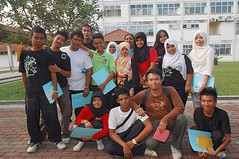
English Language Camp 2008 SMK Taman Rinting 2...Image by Roslan Tangah (aka Rasso) via Flickr
by Jean Purcell


Okay, it's not the best of English grammar, but, really, "'got blog yet?"

Where are you in the world? Wherever you are, I suspect that you are a writer.

Perhaps you are not writing a lot yet. You are unsure about what you have to offer. Do you keep a journal? Then you are a writer! Let me hear from you if you are beginning, and I will be glad to point you to resources.

Are you an author, now or in the future? Maybe you're an article writer or feature freelancer, as well.

If you have one computer at hand, with easy Internet access, you should have a blog. You can have a free blog. Search it out~and, why not a group blog? You can have a blog about the special interests of your friends or educational group. You can plan together and in that way learn together.

The easiest way to start? Some blogs are easier to set up than others. You will be able to learn as you go along. You can add as many new gadgets or widgets as you like.

Use your favorite search engines to investigate blogs...if you don't have a blog yet!

Then, check into the blogs whose bloggers can help you blog better! They can help you decide your mission, focus, unique advantages, and other good pointers.

(c) 2011 Opinari/authorsupport and Jean Purcell
Enhanced by Zemanta

Friday, February 4, 2011

Be Ready to Give Answers

When the Headline Is You: An Insider's Guide to Handling the Media (J-B International Association of Business Communicators) Successful Spokespersons Are Made, Not Born: How to Control the Direction of Media Interviews & Deliver Winning PresentationsHow to Handle Media InterviewsInterview Tactics: How To Survive The Media Without Getting Clobbered! The Insider's Guide To Giving A Killer Interview!
Whatever we are doing, we need to be ready to describe it succinctly and to tell why we do it, if we enjoy it, why, and if we find it difficult, and why, and other questions that are often part of our own inner dialogue about what's going on in our lives. 

I work with writers, and also I write. It is important to prepare written descriptions and to be ready to answer orally, depending on the inquiring media, whether print, web site and blog information ("about" tabs), and for anyone that interviews you for print, audio, or visual media: 

Be ready to answer key questions. You do not want to have to think as you answer. You want to be ready to remember what your answers really are, before the questions are asked. 

Be ready to give the same or similar answers every time. 

What kind of writing do you do? 
Short answer examples: The genres/categories of your writing-fiction, nonfiction, or personal narrative. 

Longer answer examples: If fiction/ based on a true story, or romance fiction, or adventure fiction, or historical fiction, or mystery, or children's, for example; if nonfiction, for example: how-to, essays, book (or movie) reviews, op-eds, news (or public interest) columns, biography, general information about...

What is your book about? 
Short answer example: You can choose from the genres above, with a little information: It's a novel about a family/navy,WWII, love and hate....use your information to its best advantage to spark interest.


Expanded answer example: It's a novel about two brothers caught up in a competition that threatens to destroy not only them but their community/corps/secret society....choose the best and most interesting and informative words that best describe the true central theme of the story. 

Another good example: Read the beginning of "'Mumbai Diaries' Review" in Related Articles at the end of this blog post! Notice how the words carefully selected to describe the 'about' flow to create interest.    


How long did it take you to write it? 


Are you working on anything else now? What are you working on now? Answer this kind of question in a way that will spark interest yet will not deflect interest from the present work. Refer back to the last published work and continue on its theme or title.

What helped you the most in the writing of this book (article/series, etc.)? Or, What kind of research did you have to do?


How did the idea come to you, to write about this?

How did the characters come to you, especially the villain? Is he/she modeled on someone you know?
Quote Master: How to Ace Any Print Media Interview
What do you most enjoy about writing, and why?

What is most challenging for you, as a writer? 


How are sales going? This is a very personal question. If you have a publisher, defer to the publisher, who keeps the numbers. But speak positively about the potential for interest in this book and why people should read it. 

Why should I read this book? Why should anyone read this book? This is your chance to be ready, to answer clearly and concisely. For example: I wrote to tell a story that intrigued me. I wrote to bring the reader into it along with the characters (name two key ones, perhaps), and to keep the pages turning with increased interest.


Most of all, take your time, having prepared in advance with answers that are accurate, interesting, and, perhaps, entertaining. Be ready to open yourself up without being wordy and without faltering. You should not have that shocked expression, as if you had never thought about the questions you might get. 


Every interview, every summary you write, and every mission statement or book/article description you do for yourself will help prepare you for these moments. Opportunities may come at unexpected times, when a stranger in a group after a meeting or at a get together will ask similar questions of interest. 

Be true, be interesting, and be ready!

Enhanced by Zemanta