In writing as in life sometimes we forget that all problem-solving is not up to us. As Christians who write, our work is submitted to God first, and then at times we quickly begin to despair when submissions to editors or agents do not seem to get anywhere.
Like me, you may at times feel that you have been patient enough, have persevered enough, have tried and labored enough over a specific work. And still, it languishes.
The languishing may be due to more work than you think...still undone. The 20th edit may need 10 more edits to make it shine.
However, maybe you see no reason to doubt the worth or readiness of your efforts.
When I get to such a place, I tend to try to problem-solve all by myself. "God gave me a brain, and I'm going to use it!" Networking, getting advice from other writers or people that care about you, all of that can help.
However, it is too easy to become so professional that we forget those humbling times alone in prayer when we lay it all out before the Lord, rushing nothing. We realize that the high, huge, and heavy obstacle is...you're right...too much for you or for me to handle.
It is not foolish at such times to remember: Nothing is impossible with God. It is not foolish to find every bit of scripture to remind you that He can do what no one else, no other power or principality, can do! He is God!
Believing that truth about God and relying upon it...leaning with all your weight on it...is the wisest thing in many a circumstance. You've done all you can do. So, leave it with Him! Nothing is impossible with God! It's worth remembering and repeating.
The way He leads may astound you, causing your major concern to shrink in light of what He is doing to answer your prayers! Even, yes, things far beyond what you could ask or think.
The faithfulness of God, I have learned, is a place to seek and to serve. He is faithful to the end! We lack because we forget to trust. We even may have let our love for Jesus turn lukewarm. Oh, what a thing to realize this has happened.
Stir up the fires of your love for Jesus. Use every remembrance of His remarkable kindness and faithfulness to you, His forgiveness through the sacrifice of His own life! His love to the utmost degree, the shedding of His own blood on a cross of death. That, we must dwell in, to remember what great love the Father has for us!
That is where we want to be, abiding in Jesus and His great forgiving love, His patient love, and His redeeming love. Oh, bless the Lord, my soul, and forget not one of His benefits! The psalm writer of Psalm 103 set our example, to get ourselves over the worst obstacle...any diversion from, or fading of love for, Jesus!
Whatever you are doing today, I hope that writing is not your first love. Getting over that obstacle can open our hearts toward a better time.
I hope to encourage you, as St. Paul put it, by these words!

OpineBooks.com's Author Support by Jean P. Purcell
Showing posts with label Christian. Show all posts
Showing posts with label Christian. Show all posts
Friday, April 10, 2015


Sunday, June 30, 2013
Writers, can we agree that every religion seeks God?
I am on a new journey to learn more about religions otherwise foreign to me. Recognizing my limitations, I humbly make this attempt to express where I am now and to seek other writers along this pathway.
Through different ways and histories, cultural and otherwise...religions claim to 'seek God.' This is something we share. "Seek My face," God has said in Hebrew scriptures (for example, Psalm 27:8).
Through different ways and histories, cultural and otherwise...religions claim to 'seek God.' This is something we share. "Seek My face," God has said in Hebrew scriptures (for example, Psalm 27:8).
Literature is full of cultural and religious beliefs colliding due to blindness about key similarities. For example, in The Last Mughal (I am half-way at over 400 pages), the destruction of the Mughal dynasty in Delhi, India, 1857, is connected to belief as much as to political and power conflicts. They are inherently interwoven, and the emperor's court aimed to be tolerant of Christian presence. At least at the beginning and compelled to allow their presence.
Followers saw their Delhi Mughal as being close to or second to 'God, the Almighty.' Yet, did this mean that the Mughal would have closed his mind against conversation about 'the Son of God'? I cannot help wondering about his reaction, if he had heard of Jesus as the Lord via a friend's discourse rather than a foreigner's conquering presence.
John 3:16* is truth without labels. It must have been familiar to British Christians occupying India in the 19th century. In that scripture, God shows that He is reaching out to everyone, regardless; and cultural and religious identities are not mentioned.
Jesus said (John 3:16), "God so loved the world that He gave His only begotten Son that whosoever believes on Him shall be saved" (italics added). God speaks in love to 'the world,' of His 'only begotten Son.' The receiving audience is the world; the subject and gift is the Son. The Son is not mentioned with cultural, traditional, religious, or national connections. The Son is 'culture-free' in God's broad scope for the world. Jesus speaks for God without judging other "belief systems," as they are called today. See John 3:17.
India, 19th century, included intellectual, literate, productive, artful, and wealthy persons and groups that, at first, accepted or allowed the presence of British military and East India Company ('the Company') workers. These were prominently allied with Christian faith. British families lived in homes designed to please them; they worshiped at churches built according to Indian or British design. Yet, British military leaders that harshly disrespected their hosts' beliefs and culture/way of life refused to consider them even as 'hosts.' An important few preferred to see them as 'the occupied,' or even 'the conquered.' Inevitably, the term 'Christian' and 'cruel conqueror' became synonymous. No wonder. The Mughal Dynasty of Delhi would be killed off cruelly by those identified with 'Christianity.'
A Muslim friend from India gave my husband and me a copy of The Last Mughal. As Christian and American, I find the story helps to strengthen my desire to know better the beliefs of other religions. I maintain the whole and basics of Christian faith while wanting to know more about those who are neighbors or members of the wider community, in positive ways. I will know them, I believe, as friends, at least a few. Not knowing any atheists free of argument or anger, I likely will not have dialogue there. Otherwise, the love of Christ compels this desire' to learn about how 'seeking God' has shaped others' beliefs. Seeking those loved of God strengthens my desire to seek Him continually through Christ and His ways. "God so loved the world.... I did not come to judge the world...."
If you are writing about these themes, I would like to know about your work.
*If the Bible is new to you, there is Old Testament (Hebrew and Aramaic, originally) and New Testament (original in Greek). The books have names, e.g. 'Genesis' or 'John' and chapter and verse numbers (e.g., John 3:16; or 3.16).
Friday, April 19, 2013
If You Write about the Terrorism in Boston
Christians writing about the April 15 terrorism in Boston would do well to remember basics of Muslim teaching. Because the identified bombers at the Boston Marathon had Muslim affiliation, the topic is relevant. Personally, I believe that most Muslims do not fully subscribe to the Muslim religion emphasis on intellect and knowledge. Yet, we know that minds can be dangerously influenced by terrorist sympathies.
Mind-knowledge-intellect is the triad of emphasis of Muslim teaching. Yet, the brain also hosts emotions. Why would any teachings pay attention to thought only, to the exclusion of feelings of compassion, hope, and moral good, for example?
I learned details about the intellectual basis of Islam during a meeting where a U. S.-based imam spoke about his religion. He pointed to his head and told the audience that the Koran teaches exclusive emphasis on the mind. "Mind and heart" or "mind, heart, and soul" have no assumed or direct interaction in the religion.
The imam was very reserved during the meeting where he spoke about Muslim beliefs. He said that only select Muslims like himself can correctly interpret the Koran. Only a few know the ancient language of the true Koran. He emphasized that fact repeatedly.
These teachings were evident in the imam's reaction to a question about how it felt or was difficult, after 9/11/01, when the Muslim religion was critiqued. There was no expression on the imam's face. It appeared that he took the question as being too foolish for thought, for it dealt with feelings. He gave no verbal response at all and made no movement. He ignored the question in every way possible. I wonder today if Muslim leaders exclude feelings after the Boston marathon attacks.
Mind-knowledge-intellect is the triad of emphasis of Muslim teaching. Yet, the brain also hosts emotions. Why would any teachings pay attention to thought only, to the exclusion of feelings of compassion, hope, and moral good, for example?
I learned details about the intellectual basis of Islam during a meeting where a U. S.-based imam spoke about his religion. He pointed to his head and told the audience that the Koran teaches exclusive emphasis on the mind. "Mind and heart" or "mind, heart, and soul" have no assumed or direct interaction in the religion.
The imam was very reserved during the meeting where he spoke about Muslim beliefs. He said that only select Muslims like himself can correctly interpret the Koran. Only a few know the ancient language of the true Koran. He emphasized that fact repeatedly.
These teachings were evident in the imam's reaction to a question about how it felt or was difficult, after 9/11/01, when the Muslim religion was critiqued. There was no expression on the imam's face. It appeared that he took the question as being too foolish for thought, for it dealt with feelings. He gave no verbal response at all and made no movement. He ignored the question in every way possible. I wonder today if Muslim leaders exclude feelings after the Boston marathon attacks.
I interacted with several Muslim women at that meeting. Most were friendly and smiling. I could not help thinking that feelings must be important to them. I felt at ease around them. They were willing to talk and to answer questions from non-Muslims. A few expressed being happy to meet non-Muslims. Most were Caucasian, adhering to strict Muslim dress.
In Boston on this year's April 15, two young Muslim men focused their minds on cold and heartless acts of violence. The terrorists killed and maimed innocent people, including young children. Many more would die in the hours and days ahead, because of their heartlessness. Did any Muslim teachings influence them to destroy lives by killing, maiming, and a river of suffering and loss? Somehow, survivors will overcome; yet the cause of such suffering flows from extreme mindlessness.
I hope that you will write about any aspects of the Boston marathon bombings that most disturb, inform, or influence you. Whether or not you are American or Christian, what does it mean to you as a human being with feelings? What does it mean to every thoughtful person to hear again of terrorist acts against innocent civilian people?
I feel deeply grateful to live in a country founded and built up by reasonable and peace-loving people. I am more than ever grateful for faith in Jesus Christ, who died innocent yet tormented by violent men, leaders of both political and religious powers. I am most thankful for Christ's life and His teachings of love, saving grace, and the consolations of God. "Blessed are the peacemakers; they shall be called the children of God" (Matthew 5:9). I am deeply moved to know that freedom-loving people have strong emotions, as well as thoughts, about freedom and life. Those emotions influence strength, calm, lawful justice, and peace-loving hope for better days ahead. Such days will come.
In Boston on this year's April 15, two young Muslim men focused their minds on cold and heartless acts of violence. The terrorists killed and maimed innocent people, including young children. Many more would die in the hours and days ahead, because of their heartlessness. Did any Muslim teachings influence them to destroy lives by killing, maiming, and a river of suffering and loss? Somehow, survivors will overcome; yet the cause of such suffering flows from extreme mindlessness.
I hope that you will write about any aspects of the Boston marathon bombings that most disturb, inform, or influence you. Whether or not you are American or Christian, what does it mean to you as a human being with feelings? What does it mean to every thoughtful person to hear again of terrorist acts against innocent civilian people?
I feel deeply grateful to live in a country founded and built up by reasonable and peace-loving people. I am more than ever grateful for faith in Jesus Christ, who died innocent yet tormented by violent men, leaders of both political and religious powers. I am most thankful for Christ's life and His teachings of love, saving grace, and the consolations of God. "Blessed are the peacemakers; they shall be called the children of God" (Matthew 5:9). I am deeply moved to know that freedom-loving people have strong emotions, as well as thoughts, about freedom and life. Those emotions influence strength, calm, lawful justice, and peace-loving hope for better days ahead. Such days will come.
Sunday, June 3, 2012
Knowing God
 |
| Words (Photo credit: tempestuousseas) |
“Daily, quiet reflection on the Word of God as it applies to me becomes for me a point of crystallization for everything that gives interior and exterior order to my life,” wrote Dietrich Bonhoeffer ....“Why do I meditate?” asks Bonhoeffer. “Because I am a Christian. Therefore, every day in which I do not penetrate more deeply into the knowledge of God’s Word in Holy Scripture is a lost day for me.” ...


Thursday, November 17, 2011
Reality: Reader Comment about Christian books today
 |
| (Photo credit: laz3rphea) |
Twitter @OpinariPeople and @OpineBookCafe
I heard or read this provocative comment: "I think that there needs to be more realistic Christian work from
authors who are perhaps failing and trying to get better with their
faith..."
The operative word in that thought is...realistic or faith? Faith can be a trying or tormenting word that seems to escape adequate definition or description. How can we dive into the depths of faith?
And what do we think of as "realistic" in matters of faith and other spiritual matters?
What is "realistic Christian work"?
I wonder if the commenter meant "believable because true and without embellishment or coverage. The Bible is an example of unvarnished stories, recounting human flaws in sometimes stark terms. Hebrews 11 contains lots of names, laying out that these were people of faith. To lay out their falls or foibles, we must go to the Old Testament record of their lives. "Realistic" Christian work avoids Hagiographa, or haloed writing of human lives. The full record of our lives includes flaws. Struggles with God and faith are real.
Copyright (c) 2011 Jean Purcell-post revised

Friday, November 4, 2011
Think, Reason, Believe...Pray
 |
| (Image credit: Getty Images via @daylife) |
 |
| prayer.. (Photo credit: aronki) |
Jean Purcell
The Latin word opinari means "to think, to reason, to believe." It is the root of the English word "opine," a favorite of Sherlock Holmes. Opine is the word my husband and I chose to name a place we once had, where we went to reflect, read, and discuss..."Little Opine." At Little Opine we mainly worked on the overgrown land, made repairs and trips there to take trash-bins-on-wheels to the end of the drive for pickup days.
We visited Little Opine on weekends for a couple of years. In winters, we made wood fires in its little alpine stove. Little Opine is where I started to plan for the first book of our start-up publishing company, named Opine Publishing. Exhausted Rapunzel by Deirdre Reilly became our first full-length book, a humor book by a newspaper columnist we know very well.*
We visited Little Opine on weekends for a couple of years. In winters, we made wood fires in its little alpine stove. Little Opine is where I started to plan for the first book of our start-up publishing company, named Opine Publishing. Exhausted Rapunzel by Deirdre Reilly became our first full-length book, a humor book by a newspaper columnist we know very well.*
Opinari, being the root of our name and ideas, continues to resonate with us. Think, reason, believe. Those words lead me to think pray. Writers of books for thinking readers need a life of prayer. The Psalms are a good start for those not yet practicing this.
I agree with the view that when one can hardly think, reason, or pray, we still believe. Faith remains because love remains. The times when we lean intensely into prayer for strength, steadiness, and love...are the times when it is most difficult to pray. Here is also where selected psalms can help us to pray. We can read and pray anywhere, sitting or kneeling, walking, enjoying the outdoors...
I agree with the view that when one can hardly think, reason, or pray, we still believe. Faith remains because love remains. The times when we lean intensely into prayer for strength, steadiness, and love...are the times when it is most difficult to pray. Here is also where selected psalms can help us to pray. We can read and pray anywhere, sitting or kneeling, walking, enjoying the outdoors...
Everything done through Opine Publishing has been covered in prayer. We are human and Opine is a small publishing house. The new eStore features other publishing houses' books as well as our own. "And crown our efforts with success"...the pleasures, insights, and refreshment of memorable books.
*first daughter
Opine Publishing titles:
Opine Publishing titles:
Not All Roads Lead Home/UK/original edition/Study Guide(out of print)/2000
Not All Roads Lead Home by Jane Bullard/UK/original edition/1996
Not All Roads Lead Home by Jane Bullard/UK/original edition/1996

Wednesday, October 26, 2011
Christian Writers and Spiritual Needs
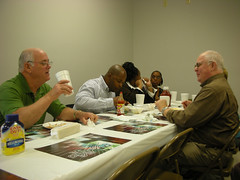 Image by Old Shoe Woman via Flickr--Christian group at church in Valdosta, GA, USA.
by Jean Purcell
editor@opinebooks.com
Follow on Twitter @opinaripeople
Commentary
We destroy every
proud obstacle that keeps people from knowing God... (2 Corinthians 10:5a-New Living Translation).
As I read from 2 Corinthians 10 this morning, I thought, "Believers face obstacles too," although the context was how to help others that seek God. You and I, as Christian writers, need reminders to destroy every proud obstacle, which is anything that prevents or tries to prevent us from knowing God. God helps us in our writing efforts if we seek Him, our dearest and wisest Guide:
When You said, "Seek My face," my heart said to You, "Your face, O LORD, I shall seek" (Psalm 27:8-NASB)
Many obstacles appear through that "terrible thing to waste," as a popular slogan says of the mind. The mind is fertile ground open to good or bad thoughts; the bad and negative ones make barriers to knowing God and to the whole-health mental life that comes from God.
As Christian authors, let's be aware of our thoughts, intentions, and actions. We are subject to the same kinds of temptations that Jesus faced. The disciples and others were, too; yet like us they lacked Jesus' perfection. John the Apostle said to acknowledge and confess our sins and to repent. This is required obedience (e.g., read 1 John).
Are we aware of proud obstacles? The psalmist prayed, "Search me, O God, and know my heart: try me, and know my thoughts: And see if there be any wicked way in me, and lead me in the way everlasting" (Psalm 139:23-25).
Let us daily seek God in such a way, God who made us. Let us enjoy the writing work clear of obstacles, in the light and freedom of Jesus Christ, our Lord.
Dear Lord, I offer deep thanksgivings and praises to You for Your salvation. Search my heart and my thoughts so that I may be with You day by day, nothing between us. Enable me to see, discern, and destroy every proud obstacle to knowing You. Amen.
Saturday, December 4, 2010
Prayer Team for These Writing Times
"Intercessors for These Times" is part of the free Opinari Quarterly writers, publishing professionals, book lovers and reviewers newsletter. Nine committed intercessors pray without always knowing names, but always knowing requests sent by subscribers.

 Jesus taught us to pray faithfully and often. We carry on this faith and prayer connection to help others in Christ. Subscribers request anonymously or by name.
From the Bible/Philippians 1/NIV-as the apostle Paul wrote: "I thank my God every time I remember you. In all my prayers for all of you, I always pray with joy because of your partnership in the gospel from the first day until now, being confident of this, that he who began a good work in you will carry it on to completion until the day of Christ Jesus.
Amen.
Jesus taught us to pray faithfully and often. We carry on this faith and prayer connection to help others in Christ. Subscribers request anonymously or by name. From the Bible/Philippians 1/NIV-as the apostle Paul wrote: "I thank my God every time I remember you. In all my prayers for all of you, I always pray with joy because of your partnership in the gospel from the first day until now, being confident of this, that he who began a good work in you will carry it on to completion until the day of Christ Jesus.
Amen.
Subscribe to:
Comments (Atom)